Perception & Cognition
Sensory Response in Active Movements
(Review 2007, J. S. Longstaff)

Sensory response and resulting perception & memory / recall are shown to be greatest from:

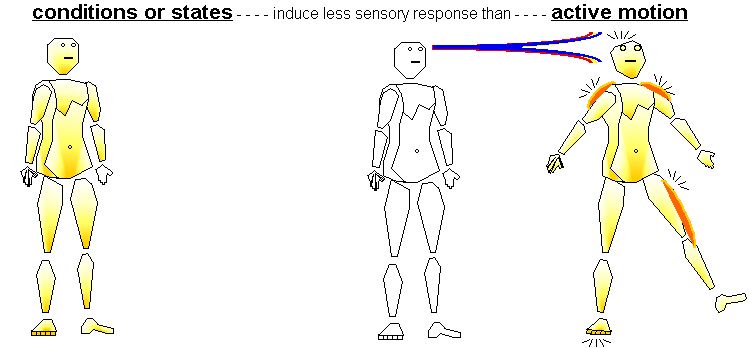
1. Movement, compared to still body positions
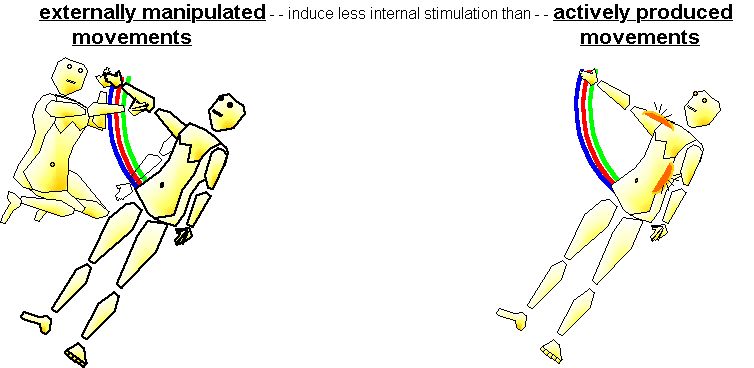
2. Actively produced, compared to motion from an external source (person, machine)

Sensory Receptor Adaptation:

During stillnesses, receptors gradually adapt to the condition decrease their discharge level to a lower intensity.

Movement, changes in length and tension of body tissues, stimulates receptors to discharge at a higher intensith.

- muscle spindle receptors
- tendon receptors
- joint receptors

Vestibular system behaves in the same way

- During stillness (or steady-speed velocity) endolymph fluid in the inner ear becomes quieter, thus stimulating the receptor nerves less, while;
- During body movement (changes of velocity), fluid moves in the inner ear thus inducing greater vestibular stimulation.

Notes:

When muscles are actively contracting there will be greater sensory discharges from muscle spindle receptors (Matthews, 1933; McCloskey, 1978, p. 770), tendon receptors (Jansen and Rudjord, 1964) and joint receptors (Grigg, 1975; Skoglund, 1956).

Similarly, the longer an arm is held in a static position, the less well its position can be matched by the opposite arm (Paillard and Brouchon, 1968; 1974). Presumably this occurs because response from quickly adapting muscle primary spindles and other quickly adapting have much less response after a brief time with no movement.

REFERENCES AT:

http://www.laban-analyses.org/jeffrey/1996_phd_thesis/phd_references.htm
Active Control:

A position achieved by external manipulation (by another person),
                is recalled less well
                       ... than a position actively moved to.

When movements are produced and controlled actively by the person moving, it leads toward:

- Greater sensory response from active muscle tension, compared to relaxed muscles-tendons
- Central feedback or "Efference", an internal knowledge of motor comands initiated by the mover.


Notes: Arm positions which are actively moved to are recalled better than positions which are imposed by the experimenter onto the subject’s passive arm (Jones, 1972; Kelso, 1977b; Marteniuk, 1973; Paillard and Brouchon, 1968; 1974; Roy and Williams, 1979).

This effect of better position recall from active movements also indicates the use of efferent data for deriving the perception of limb position. This is demonstrated when subjects are allowed to actively move their arm to an end-location of their own choosing. In this condition efferent data would be available and recall of the end-location is most accurate.

REFERENCES AT:

http://www.laban-analyses.org/jeffrey/1996_phd_thesis/phd_references.htm